Is Your School at Risk of Collapse?
In September 2023, more than 100 schools in England closed over RAAC concrete fears. Here's what the hidden danger in school roofs means for your estate — and how to act before there's a visible warning.
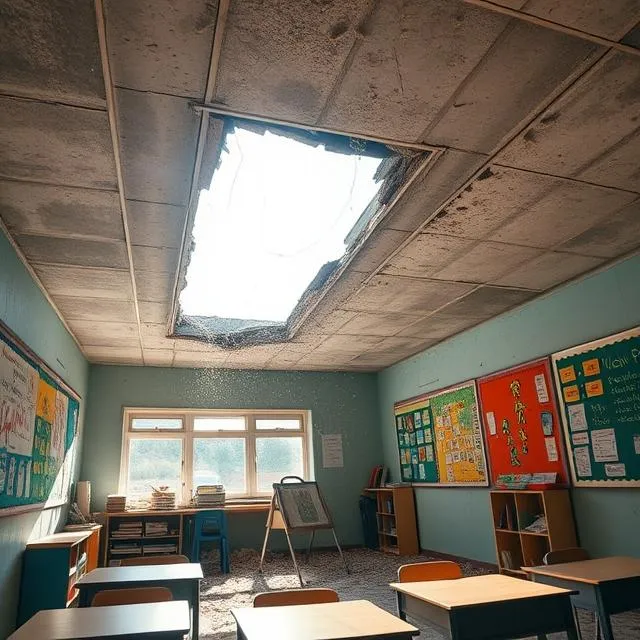
The hidden danger lurking in school roofs across the UK.
In September 2023, more than 100 schools across England were forced to partially or fully close due to concerns over Reinforced Autoclaved Aerated Concrete (RAAC) — a now-degraded material lurking in the roofs, walls, and floors of buildings constructed between the 1950s and 1990s.
One particularly stark example was St Clere’s School in Essex, where a classroom ceiling collapsed without warning over the summer holidays. Thankfully, the school was empty at the time, but the outcome could have been devastating had it occurred during term time. (Source: BBC News, Sept 2023 — “More than 100 schools told to shut buildings over concrete fears”.)
Meanwhile, Hockley Primary School in Essex and Outwoods Primary School in Staffordshire were among several that had to delay the start of term, switching to remote learning or temporary accommodations. These incidents aren’t outliers — they’re part of a growing pattern of concern over the structural safety of our school buildings.
What is RAAC — and why is it dangerous?
RAAC is a lightweight, bubbly form of concrete that lacks the gravel or stone aggregates used in traditional concrete. It was used in public buildings from the 1950s until the mid-1990s due to its affordability and ease of installation.
Decades later, its weaknesses have become clear:
- It absorbs moisture easily
- It deteriorates faster over time
- It can fail suddenly without visible warning signs
In August 2023, the Department for Education escalated its guidance, urging schools to treat RAAC as a critical safety risk and act immediately if it is suspected.
Could this happen at your school?
If your school was built between 1950 and 1995, there’s a significant chance RAAC was used — especially in flat-roofed structures. Many school leaders and estate managers are unaware of its presence until it’s too late.
Red flags include:
- Cracked, sagging, or discoloured ceiling panels
- Evidence of water ingress
- Gaps in documentation around construction or maintenance
- No recent structural surveys
Don’t wait for a visible warning. In many cases, there isn’t one.
How we help schools stay safe
At dhp, we specialise in making school environments safer, smarter and future-proof. We’ve helped schools across the UK identify, remove and replace RAAC elements safely — and we understand how critical it is to move quickly, responsibly and within tight budgets. Our RAAC safety services include:
- Structural surveys to identify and assess RAAC risks
- Design and delivery of safe remedial works
- Support with educational funding applications (CIF, PSPB2, LCVAP, HPCF and local authority capital maintenance grants)
- Full project management with minimal disruption to school operations
Why you must act now
RAAC isn’t just a compliance issue — it’s a safety threat. Some schools were forced to close just days before the 2023 academic year started, leaving students, teachers and families scrambling for alternative arrangements. This can be avoided with proactive planning and expert guidance.
At dhp, we’re more than designers — we’re trusted advisors to the education sector. We work with headteachers, trust leaders and estate managers to deliver long-term safety and value through thoughtful, future-ready design.
Contact us today to arrange a consultation and take the first step toward securing your school’s future.
References: BBC News — “More than 100 schools told to shut buildings over concrete fears” (Sept 2023); The Guardian — “Full list of schools in England affected by RAAC concrete crisis” (Sept 2023); Gov.uk — RAAC management guidance for schools (2023).